Final meeting with Julia
The final meeting between Winston Smith and Julia is the last act of their love story and the novel’s proof that the Party has destroyed whatever it could not confiscate. It takes place by chance in the Park on a bitter March day, after the two have been released from the Ministry of Love, and it reduces them to strangers who have each betrayed the other and who no longer feel the same. The encounter is the bleak counterpart of their first love-making in the Golden Country: the same couple, the same possibility of being alone together, and none of the feeling that once made their embrace a political act.
The Circumstances of the Reunion
Neither of them had sought the meeting. Since their release the authorities had taken almost no interest in Winston’s doings, and he could have arranged another encounter if either of them had wanted one; it happened by chance. The day was vile and biting, the earth like iron, all the grass seeming dead, with only a few crocuses pushing themselves up to be dismembered by the wind. Winston was hurrying along with frozen hands and watering eyes when he saw her not ten metres away, and he knew at once that she had changed in some ill-defined way. She walked obliquely away across the grass as though trying to get rid of him, then seemed to resign herself to having him at her side. They halted among a clump of ragged leafless shrubs, useless for concealment or shelter, and he put his arm round her waist. She made no response, and did not even try to disengage herself. There was no telescreen, though hidden microphones were probable and they could be seen; but it did not matter, nothing mattered. The thought that they could have lain down on the ground if they had wanted to made his flesh freeze with horror.
What the Party Had Made of Her
Standing beside her, Winston understood what the vague change was. Her face was sallower, and a long scar, partly hidden by her hair, crossed her forehead and temple; but the true alteration was in her body. Her waist had grown thicker and, in a surprising way, stiffened. He remembered helping to drag a corpse out of some ruins after a rocket bomb, astonished by its incredible weight and by a rigidity which made it seem more like stone than flesh; her body felt like that. It occurred to him that the texture of her skin would be quite different from what it had once been. He did not attempt to kiss her, nor did they speak as they walked back across the grass. Then, for the first time, she looked directly at him, a momentary glance full of contempt and dislike, and he could not tell whether it came purely out of the past or was inspired also by his bloated face and the water the wind kept squeezing from his eyes.
The Double Confession
They sat down on two iron chairs, side by side but not too close together. He noticed that she moved her clumsy shoe a few centimetres and deliberately crushed a twig; her feet, like her waist, seemed to have grown broader. Then she said baldly, "I betrayed you." He answered, "I betrayed you." She gave him another quick look of dislike and explained what the words meant: when people were threatened with something they could not stand up to or even think about, they tried to transfer the horror to somebody else and beg that it be done to that person instead. Afterwards one might pretend it was only a trick, but at the time one meant it; one was quite ready to save oneself that way, and did not give a damn what the other person suffered. "All you care about is yourself," she said, and he echoed the words. "And after that, you don’t feel the same towards the other person any longer." "No," he said, "you don’t feel the same." This exchange is the recognition at the heart of the scene: the feeling that once made their bodies a standing revolt against the Party has been burnt out of both of them, and they know it together.
The Parting
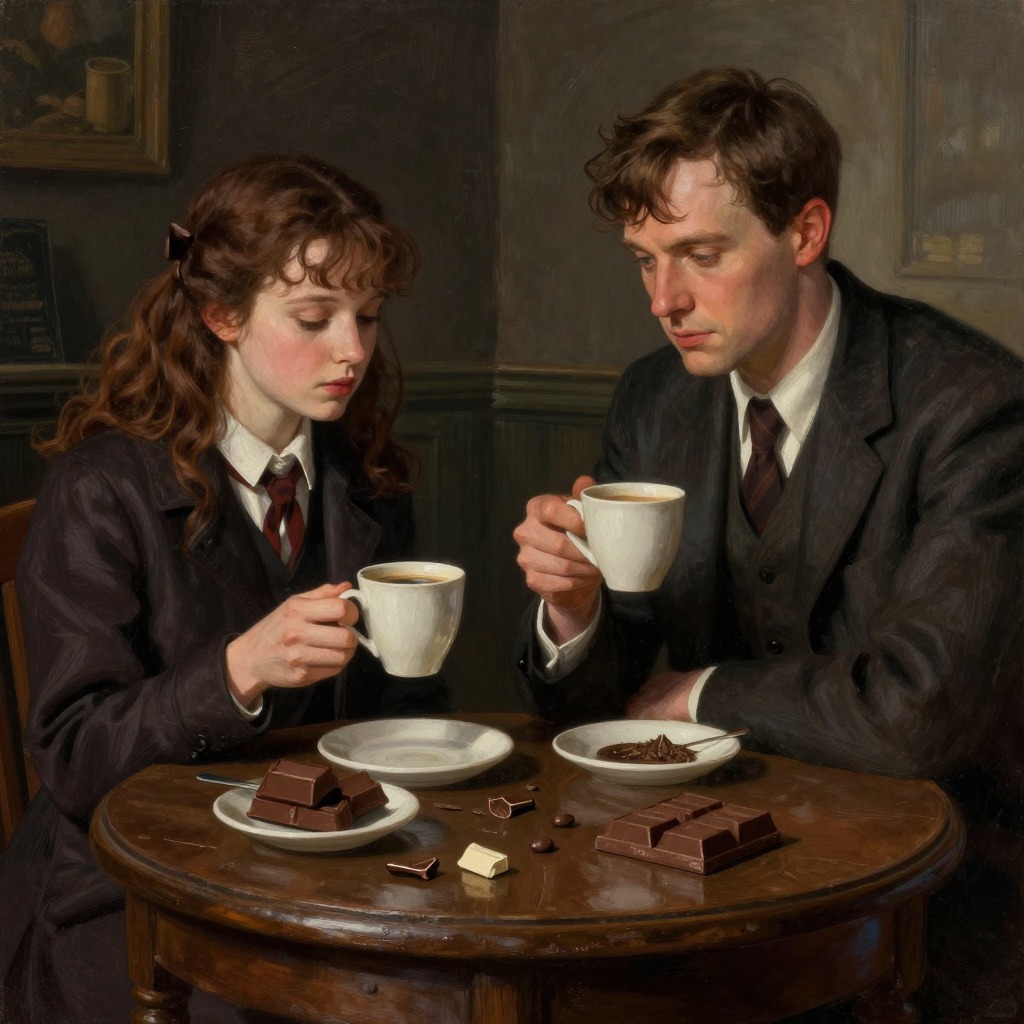
There did not seem to be anything more to say. The wind plastered their thin overalls against their bodies; the silence was embarrassing and the cold made stillness unbearable. She said something about catching her Tube and stood up to go. "We must meet again," he said. "Yes," she said, "we must meet again" — the ritual words emptied of intention. He followed irresolutely, half a pace behind her, and she walked at just such a speed as to prevent his keeping abreast. He had meant to accompany her to the Tube station, but suddenly trailing through the cold seemed pointless and unbearable. A desire swept over him, not so much to get away from Julia as to get back to the Chestnut Tree Café, with its nostalgic corner table, the newspaper, the chessboard and the ever-flowing gin — above all, its warmth. The next moment, not altogether by accident, a small knot of people separated them; he made a half-hearted attempt to catch up, then slowed, turned and made off in the opposite direction. When he had gone fifty metres he looked back. The street was not crowded, but he could no longer distinguish her; any one of a dozen hurrying figures might have been hers. Perhaps, he thought, her thickened, stiffened body was no longer recognisable from behind.
Aftermath and Significance
The meeting completes the destruction begun in Room 101. Julia had once told Winston that the Party could make a person say anything but could not make them believe it; the final meeting is the refutation of that hope. From the moment when, facing the rats, Winston had screamed "Do it to Julia", each of them had already committed the betrayal that turns this reunion into an exchange between two ruined bodies. O’Brien had told him that what happens in the Ministry of Love is for ever, and the prophecy here proves itself in the simplest details — a thickened waist, a scar, a glance of contempt, two people who no longer feel the same. The scene inverts the romance’s happy ending: the lovers are alive, free to walk the same park, safe from surveillance, and entirely dead to one another. It is also the last time Winston appears with any remnant of a private self; afterwards he will drift towards the Chestnut Tree Café, chess problems, gin, and finally the love of Big Brother.